



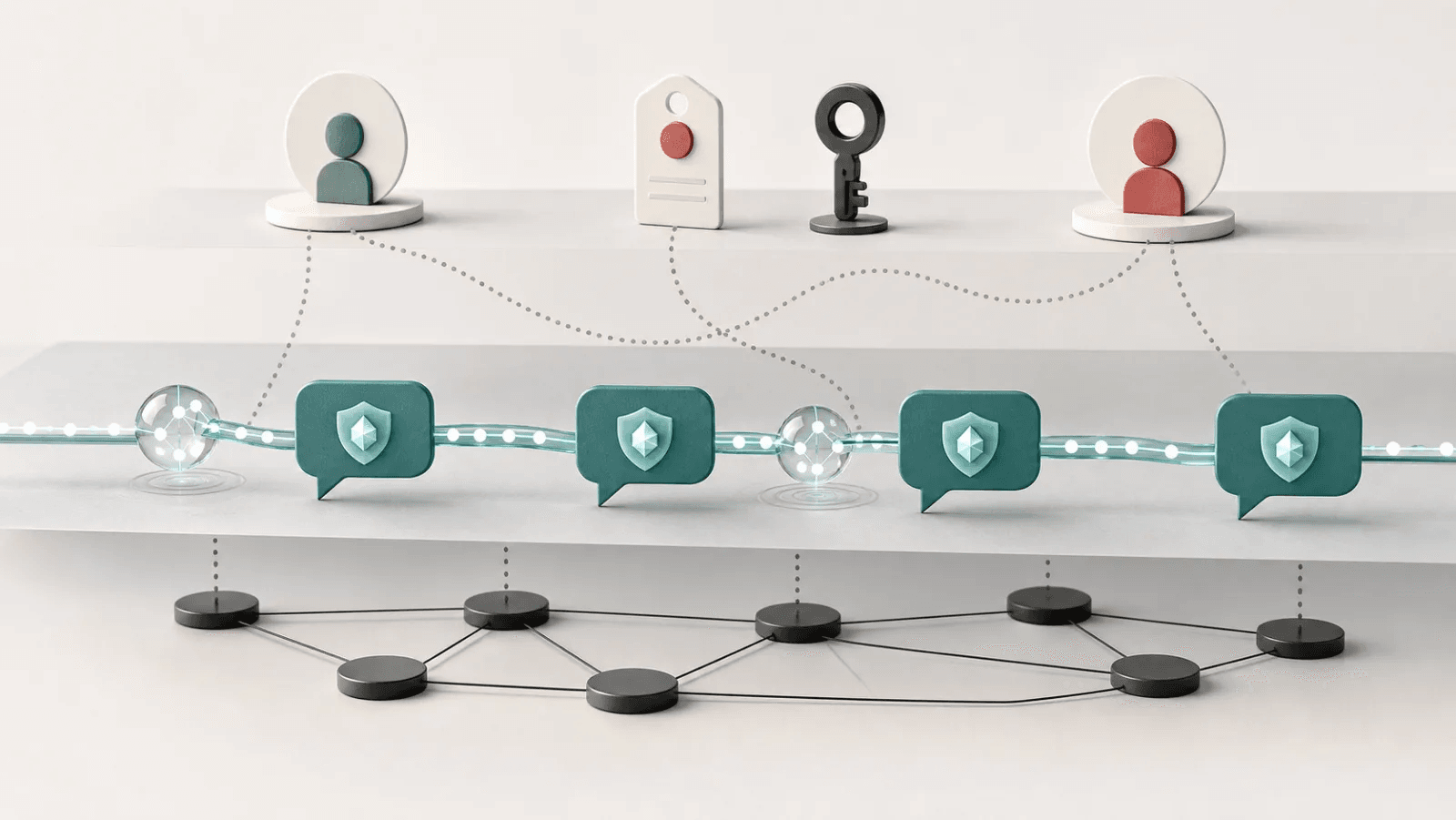
If you are searching for an anonymous messaging app, do not start with the app-store promise. Start by separating the identity layers. A messenger is not anonymous because it says messages are encrypted. It becomes meaningfully private only when the product reduces the ways a real person can be linked through account creation, contact exchange, network path, recovery, group membership, payment trail, device state, and operator records. That layered test is how I am building UmbrellaX.
The short answer: an anonymous messaging app should not be judged as one binary feature. It should be judged by how many identity joins it removes and how clearly it explains the joins that remain. If a product cannot explain those layers, I would not treat it as anonymous. I would treat it as encrypted chat with unknown identity risk.
The answer first
An anonymous messaging app is a messenger designed to reduce identity linkage across the whole communication path. That means the app should not require a phone number as the account root, should not force address book upload, should limit metadata collection, should protect message content with end to end encryption, should avoid weak SMS recovery, should explain its jurisdiction, and should make operator logs small enough that legal or operational pressure has less to seize.
I do not believe absolute anonymity is a responsible product promise. A user’s device can be compromised. A user can reveal themselves in writing. Network paths can leak. Payments can identify. Social patterns can expose. My practical test is narrower and more honest: does the messenger remove avoidable identity links before the first message is sent?
UmbrellaX is being built to pass that test. The goal is not to make mystical claims. The goal is to design the system so the service starts with less knowledge.
Anonymous is not the same as encrypted
End to end encryption is necessary, but it is not the same thing as anonymity.
Encryption protects the message body from the server and from ordinary network observers. That matters. I would not build a private messenger without encryption by default, and I explain the foundation in end to end encryption explained. But a person can be exposed even when the ciphertext is strong.
The account can be tied to a phone number. Contact discovery can reveal who knows whom. Backups can create a second copy. Recovery can hand control to a carrier workflow. Timing and IP data can create a pattern. Group membership can expose associations. Support logs can preserve facts the product never needed to keep.
That is the difference I want readers to understand. Encryption answers one question: can the service read the conversation? Anonymity asks a wider question: can the service, a partner, an attacker, or a legal process connect this conversation to a person?
Start with the identifier
When I evaluate an anonymous chat app, I start with signup.
If the first required field is a phone number, the product has already made a major privacy tradeoff. A phone number is not just a login convenience. It is connected to carriers, SIM registration, billing records, recovery systems, other people’s address books, old accounts, breached datasets, and number recycling. I wrote a separate guide to the messenger without phone number problem because this one design choice changes everything downstream.
No phone number does not automatically create anonymity. It only removes one of the strongest identity links. The next question is what replaces it.
My preference is a model based on keys, handles, QR codes, and one time contact flows. It asks for a little more deliberate action from the user, but that is a tradeoff I accept. I would rather make contact exchange slightly slower than make the user’s carrier identifier the root of a supposedly anonymous account.
Contact exchange is the consent layer
The dedicated contact-discovery problem belongs in its own article, so I will keep the anonymity test narrower here: who gets to create the relationship?
Many messaging apps make the operator the first broker of trust. The app asks for contacts, compares identifiers, and turns the address book into a growth surface. That may make the app feel alive quickly, but it also changes the anonymity story. The user did not just create an account. The user gave the product a way to reason about relationships.
For an anonymous messaging app, I prefer deliberate contact exchange: QR codes, handles, scoped invite links, one time contact tokens, or other consent-based paths. Those mechanisms are not perfect anonymity. They are a better starting point because they make the relationship an action between users rather than an automatic database match.
That is different from the deeper contact discovery privacy question, where the issue is matching protocol design, enumeration resistance, retention, and address-book exposure. Here the point is simpler: anonymity gets weaker when the first relationship is created by uploading a list instead of choosing a contact.
Operator knowledge is the evidence layer
Metadata is the broad topic. Operator knowledge is the anonymity version of it.
The IETF privacy guidance around protocols is clear about identifiers, observability, linkability, and retained data. In an anonymity context, I translate that into one operational question: if the operator is compelled, compromised, or acquired, what story can it tell about the user without decrypting a message?
The answer may include account creation events, invite links, group membership changes, device links, recovery attempts, abuse reports, support records, IP-derived routing data, and payment metadata. Some records may be necessary for a working service. Some are convenience residue. Some should never exist.
UmbrellaX treats this as a database-design constraint, not only a policy statement. The product is pre-launch, so I will not claim production proof that does not exist. What I can state is the standard: every retained field should have a purpose, a limit, and a reason it belongs in an anonymity-respecting messenger.
For the wider treatment, read private messenger metadata. This page is the identity-layer guide; that page is the operator-knowledge deep dive.
Network anonymity is a separate layer
Some users need protection from network observers. That is a different layer from account anonymity.
Tor is built to help separate users from destinations through relays. Briar uses Tor for internet transport and can also work through local paths such as Bluetooth or Wi-Fi when the internet is unavailable. These are serious design choices, and they are useful for specific threat models.
But I would not collapse every private messenger requirement into “must be Tor” or “must be peer to peer.” There are tradeoffs in speed, reliability, notifications, abuse handling, large groups, multi-device use, and account recovery. A messenger for high-risk field work may choose different defaults from a messenger designed for broad everyday use with strong privacy foundations.
My rule is to separate the layers. Does the account model avoid phone numbers? Does message content use strong encryption? Does the product reduce metadata? Does it offer or support network privacy where the threat model requires it? Does it tell users the truth about what is protected and what is not?
That layered view is more useful than pretending one architecture solves every risk.
Recovery is part of the anonymity test
Recovery is where many private systems quietly become less private.
If account recovery depends on SMS or voice calls, the carrier becomes part of the identity and control path. NIST treats PSTN-based out-of-band authentication as restricted because the phone network has known weaknesses. For anonymous messaging, the issue is not only account takeover. It is identity binding.
I do not want UmbrellaX recovery to make a phone number the hidden authority behind an account. The hard product problem is to give users a way back into their account without turning recovery into a surveillance shortcut or an attacker-friendly reset button.
That means recovery has to be designed with tradeoffs in the open: recovery keys, device approvals, backup encryption, social recovery, or other mechanisms each have costs. I would rather make those costs explicit than hide behind a smooth SMS flow that weakens the whole privacy story.
For a related layer, read encrypted chat backups. Backups can help users survive device loss, but they can also become the place where private conversations are copied into a weaker system.
Groups make anonymity harder
One to one chat is the easy version of the problem. Groups are harder.
In a group, the system has to manage membership, key changes, device additions, removals, invitations, history visibility, and abuse controls. Every one of those choices can expose relationship data. A product can be strong for one to one messages and still weak for groups if group membership and key management are treated as secondary features.
That is why UmbrellaX points toward MLS for secure groups. I care about group security as a first-class primitive, not an afterthought. This does not mean groups become magically anonymous. It means the encryption architecture should be capable of handling group changes without relying on vague promises.
If your anonymity need involves activist circles, journalist-source networks, legal teams, or sensitive communities, group design matters. Ask how members are added, how removals work, what the server can infer, and whether the product has a real answer for large private groups.
Jurisdiction still matters
Jurisdiction is not a magic shield. It is a pressure surface.
An operator exists somewhere. It has directors, infrastructure, contracts, payment rails, and legal obligations. If a messenger stores very little, jurisdiction matters less. If a messenger stores too much, jurisdiction matters more. The strongest posture is to combine operator data minimisation with a legal home that users can reason about.
UmbrellaX TOO is registered in Kazakhstan, outside the Five Eyes. I do not present that as a spell that defeats every request. I present it as one part of a deliberate privacy model: choose the account root carefully, minimise operator data, document the legal entity, publish a warrant canary, maintain transparency, and avoid collecting fields that make pressure more valuable.
That is the practical difference. I cannot stop the world from asking questions. I can design the product so there is less useful data to demand.
My practical test for an anonymous messaging app
When someone asks me whether a messenger is anonymous, I do not ask whether the website uses the word anonymous. I ask these questions:
- Does signup require a phone number?
- Can I exchange contacts without uploading my address book?
- Is end to end encryption on by default?
- What metadata does the operator say it can see?
- How does recovery work without SMS?
- What happens to backups?
- How are secure groups handled?
- Where is the operator legally based?
- Does the product explain abuse controls without turning them into surveillance?
If a product cannot answer these questions, I assume the anonymity claim is incomplete.
Where UmbrellaX fits
UmbrellaX is pre-launch, and I am not going to pretend it has years of public production history. That would be the wrong kind of trust signal.
What I can explain is the design posture. UmbrellaX is being built as a privacy-first messenger that treats anonymity as layers: account identity first, contact exchange second, metadata and network exposure third, recovery and groups fourth, jurisdiction and operator records fifth. The product is not trying to win trust by using the biggest word. It is trying to reduce the number of things users have to trust.
I would choose UmbrellaX when the user wants a messenger designed around identity restraint from the beginning: fewer account links, less operator knowledge, clearer jurisdiction, and a group-security path that is not bolted on later.
I would not trust any messenger, including UmbrellaX, to solve a threat model the user does not understand. If your adversary controls your device, watches your network, knows your writing style, or can pressure your contacts, no app name makes you anonymous. Good privacy software reduces exposure. It does not replace judgement.
The bottom line
The best anonymous messaging app is not the one with the boldest claim. It is the one with the smallest avoidable identity surface.
My standard is simple: no phone number as the account root, no forced address book upload, encryption by default, metadata minimisation, recovery that does not hand authority to the carrier, serious group design, and jurisdiction that is part of the privacy model rather than an afterthought.
That is the direction I am taking UmbrellaX. I want the messenger to know less before the first message, keep less while the service runs, and expose less if pressure arrives later. That is not absolute anonymity. It is a more honest foundation for private communication.
Sources
- IETF RFC 6973: Privacy Considerations for Internet Protocols official
- Tor Project: What is Tor official
- Electronic Frontier Foundation: Communicating with Others official
- NIST SP 800-63B-4: Authentication and Authenticator Management official
- Signal: Technology preview for sealed sender official
- Briar: How it works official
- UmbrellaX privacy policy official